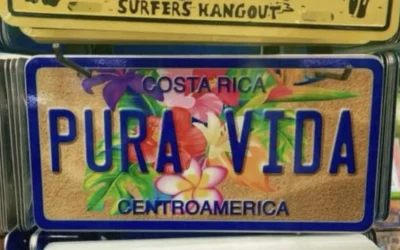
Discover Costa Rica’s Typical Oxcarts & What They Are Used for

Before cars and other forms of transportation even existed in Costa Rica, people used a car made of wooden wheels to move around from one part of the country to another. These were the Oxcarts.

Its origins can be traced back to the mid-nineteenth century, when they made their way from Costa Rica’s Central Valley, traversing mountainous paths to reach Puntarenas on the Pacific Coast.

The traditional Costa Rican oxcart, or “carreta” in local parlance, is one of the country’s most illustrious crafts and has received recognition from UNESCO.

Nowadays, they have become a colorful remembrance of the legacy of past generations and a beloved craft among locals and tourists alike.
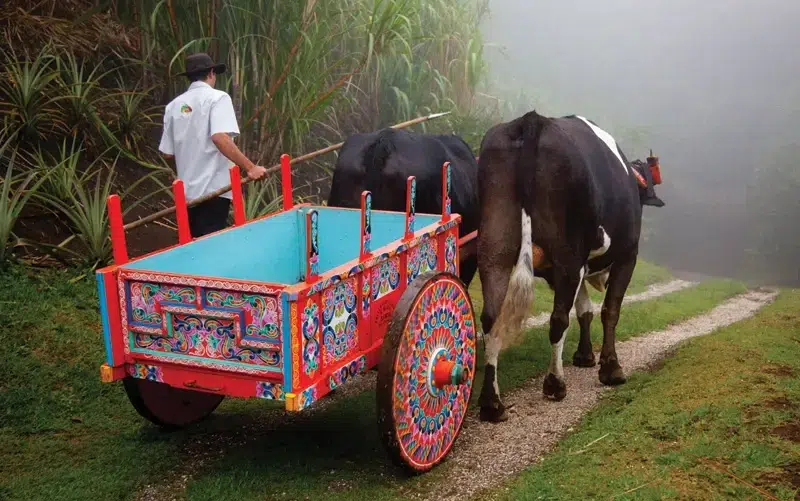
The Costa Rican Oxcart carries a legacy of craftsmanship, agriculture, and art.

The Story Behind Costa Rica’s National Oxcarts

According to the Oxherd House Museum, in the beginning, oxcarts were made from wood and had no decorations. But then people started painting them with many colors and artistic designs.

The first oxcarts in Costa Rica were simple and plain, made only from wood. They had spoked wheels that got stuck in the rough, muddy land. But during the mid-19th century, a new wheel design came into play.

Based on an ancient Aztec style, this new design used solid wood wheels with a metal band. These wheels could handle the mud without getting stuck.

To keep the wheels safe, people apply a kind of paint called minium powder or lead oxide. This paint mixed with oil could make the wheels orange and red, and it also protected them from damage. This discovery was a big deal for decorating oxcarts later on.


The painted Oxcarts Of Sarchi

The painting and decoration of oxcarts began at the Joaquin Chaverri Oxcart Factory in Sarchi in 1902, a town known for its artisans. For over 100 years, farms near Sarchi have produced some of the country’s best coffee beans. Therefore, the need for a sturdy way to transport coffee beans to coastal ports led to the demand for oxen-pulled carts.

According to the story passed down in the family of Joaquin Chaverri, Joaquin decorated his cart so that he could take his family on Sunday outings. According to his family, he painted his first oxcart orange because it was the only color he had available. As a result, orange and red have become the most traditional colors for painting carts.

Chaverri’s family members say that Joaquin wanted the designs to stand out from other kinds of art at the time. Having no ready-made brushes, he made his own from dogs’ hair. His decorations were based on Costa Rican plants and flowers, and his wheels were decorated with spear-tip shapes.

Over time, Oxcarts were painted with local designs meant to help others identify the origin of each cart. As the movement grew, ox herders began including more designs, like flowers or portraits of people, and sometimes even beautiful landscapes. Soon, the designs on oxcarts became an area of pride for ox-herders and their local regions.


What was originally transported by the painted oxcarts of Costa Rica?

Traditionally, the oxcart was used in Costa Rica as a form of transportation and a means to carry goods from one place to another. For many families, the oxcart was the sole means of transportation and a vital part of their survival. 

Some of the main goods that Costa Rica exported were coffee, sugarcane, and corn. The oxcarts loaded up the cargo at the plantations and traveled on small, rough roads to the main ports. This trip could sometimes take up to 15 days.


Are Oxcarts Still Used in Costa Rica?

Believe it or not, some people in Costa Rica still use oxcarts for transportation. However, these oxcarts are no longer primarily used for traveling between different areas. Instead, they are often employed to move products during harvest season or in areas where the terrain is too rugged for modern vehicles.

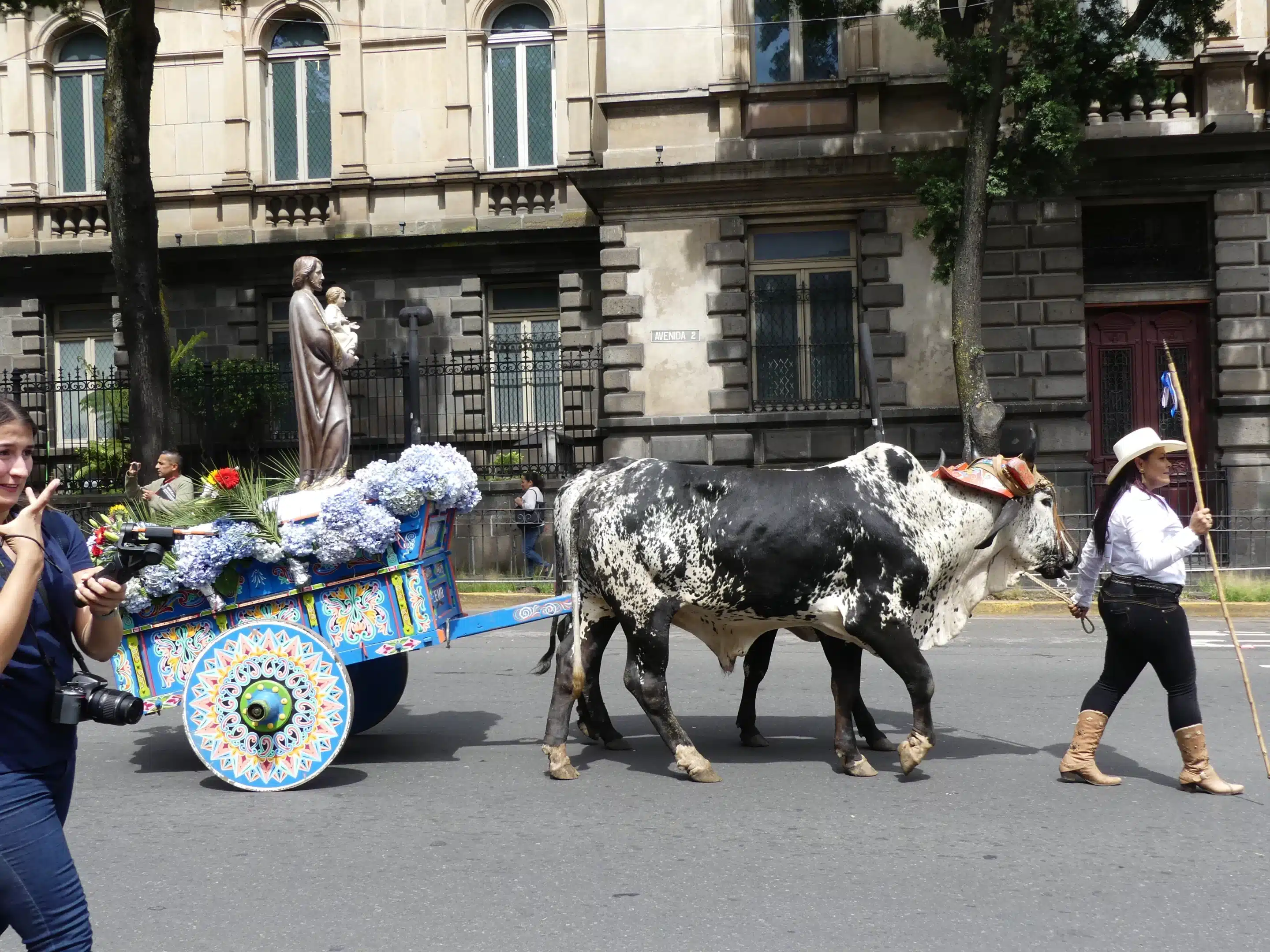
Nevertheless, Oxcarts in Costa Rica remain powerful symbols of the country’s rural heritage and vibrant Costa Rican culture. As a result, you can spot them in parades, festivals, and various celebrations.
A Costa Rica National Oxcart showcases the artistic traits of the Costa Rican people.

Where To See Painted Ox Carts In Costa Rica

If you’re eager to witness this historical emblem up close, visiting the epicenter of oxcart craftsmanship, Sarchí, is a must. Here, you’ll encounter the world’s largest ox cart.

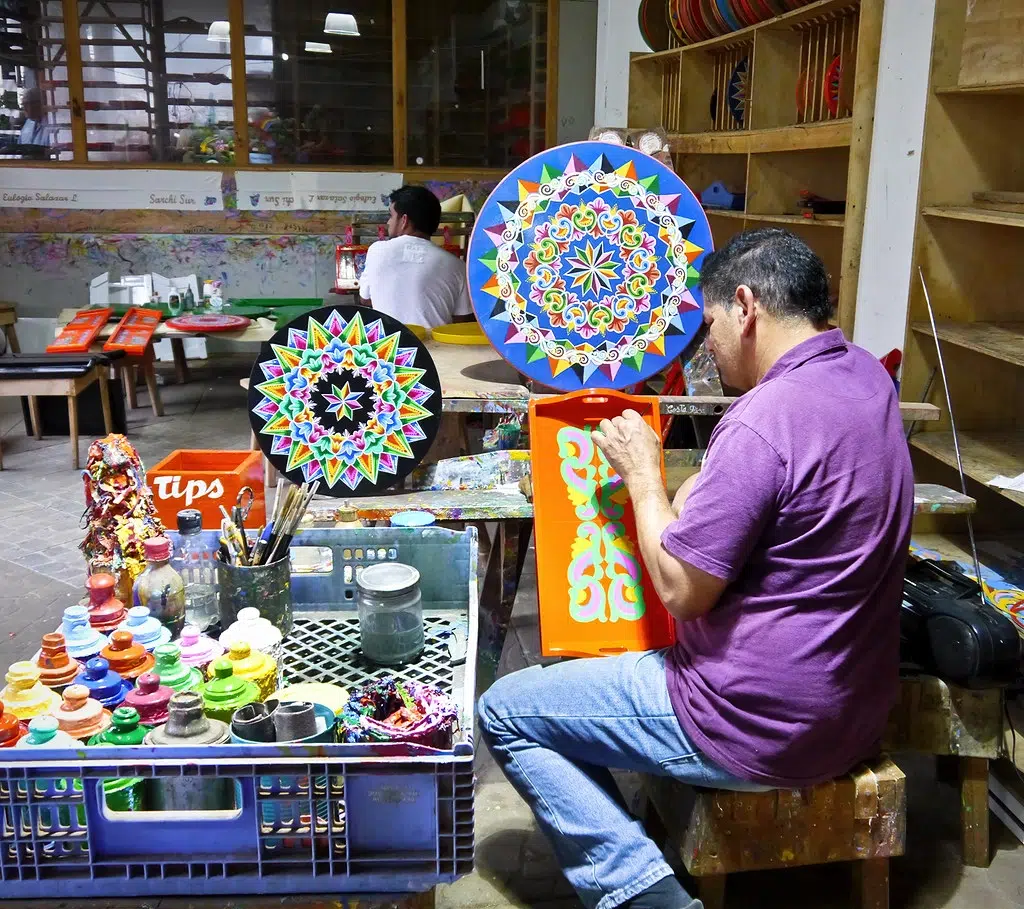
In Sarchí, two factories stand ready to welcome you into the world of traditional oxcart crafting and painting. The Joaquin Chaverri Ox Cart Factory and the Eloy Alfaro Ox Cart Factory host daily demonstrations, allowing you an intimate glimpse into the intricate process.

Observe the artistry behind painting oxcarts and embark on a journey to uncover their skills.
Observe a vibrantly painted Costa Rica ox cart showcasing traditional artistry and culture.

Plan Your Visit and See the Colorful Oxcarts in Costa Rica

Visiting Costa Rica today and seeing the colorful oxcarts is a reminder of its rich history. Nowadays, they’re more than just vehicles; they stand for the country’s spirit and determination to keep going. To learn more about these inspiring ox cart designs, don’t hesitate to contact Find My Costa Rica.

Our local guides are more than ready to assist you in every way. We’ll ensure you get to all the exciting destinations on your trip to Costa Rica. We invite you to keep reading our blog so you can continue exploring more of our country.


The rainy season is genuinely wonderful for travelers who prepare for it. Crowds are smaller, forests are greener, and waterfalls are at their most dramatic. It rains hard, but usually in defined afternoon windows — mornings are often clear.

Want the full picture? Our guide to Costa Rica’s rainy season covers what to expect region by region.

What to pack by activity

Do not repeat your master checklist here these are the additions that matter for specific trip types. Grab what applies to your itinerary and leave the rest.

Beach and water sports

  • Rash guard sun protection in the water is more effective than sunscreen alone
  • Waterproof phone case or action cam housing
  • Reef-safe sunscreen mandatory in marine reserves; this is not a suggestion
  • Water shoes for rocky beaches and shallow reef walks

Hiking and national parks

  • Trekking poles especially useful on steep, wet trails in Corcovado or Chirripó
  • Gaiters for deep mud on rainy season trails
  • Extra headlamp batteries early morning wildlife walks start before dawn
  • Microfiber towel compact and dries fast between hikes

Wildlife watching

  • Binoculars note that most FMCR partner guides carry loaners, so check with your guide before packing yours
  • Zoom lens (200mm or more) for photographing birds and monkeys at distance
  • Early-morning layers wildlife is most active before 8am when temperatures are still low
  • Silent, dark-colored clothing neon colors startle wildlife

City and culture (San José and beyond)

  • Money belt or anti-theft bag  pickpocketing exists in busy market areas
  • Light cardigan or blazer for nicer restaurants
  • Comfortable walking shoes  cobblestones in Barrio Amón are tough on sandals
Traveler enjoying a Costa Rica sunset view from a scenic overlook

What NOT to pack for Costa Rica

This is the section most travelers wish they had read first. Overpacking is the number one complaint we hear from guests on their first day. Less really is more when you are moving between regions.

Jeans: They never fully dry in the humidity. Swap them for quick-dry pants or shorts and thank yourself on day two.

High heels or dress shoes: You will not need them. Even nice restaurants in Costa Rica are casual. One pair of clean trail sandals does the job.

Too many shoes: Three pairs maximum: waterproof sandals, trail shoes, and flip flops. Shoes are heavy and take space.

Non-reef-safe sunscreen: It is prohibited in several reserves and harmful to marine ecosystems. Bring reef-safe from home. Brands like Raw Elements and Badger are good options.

A hair dryer: Almost every hotel and lodge provides one. Leave yours at home.

Valuables you cannot afford to lose: Leave the expensive jewelry and the laptop you need for work. Use your trip as a proper break.

Cotton everything:Cotton absorbs moisture and stays wet all day. Pack synthetics or merino for everything except maybe one casual outfit.

Practical tips for packing smart: documents, money, and tech

Your passport must be valid for the full duration of your trip.

Customs also requires a tiquete de salida proof of onward travel out of Costa Rica. This can be a return flight or a bus ticket to a neighboring country. Have it printed or easily accessible on your phone. See Costa Rica national park regulations via SINAC for entry requirements at protected areas.

Money

  • Colones (CRC) are the local currency; USD is widely accepted but change is given in colones
  • ATMs are available in most towns withdraw colones there rather than exchanging at the airport, where rates are poor
  • Visa and Mastercard accepted at most hotels, restaurants, and tour operators; carry some cash for small sodas and local markets

Health prep

Check the CDC health recommendations for Costa Rica before your trip they cover vaccines, repellent, and food safety guidance. Travel insurance is not required by law, but we strongly recommend it for anyone doing adventure activities.

Tech

  • Costa Rica runs on 110V/60Hz US travelers need no adapter or converter
  • Cell coverage is solid in tourist areas; download offline maps before heading into remote zones
  • WhatsApp is the primary communication tool in Costa Rica make sure it is installed and working


Tropical hot springs surrounded by rainforest in Costa Rica
Do I need a visa to visit Costa Rica?

US, Canadian, and UK citizens do not need a visa to enter Costa Rica for stays up to 90 days. Your passport must be valid for the full duration of your trip. You will need to show a return or onward ticket at customs.

Is tap water safe to drink in Costa Rica?

Yes in most areas. Tap water in San José, Guanacaste, La Fortuna, and other major tourist regions is safe to drink and often tastes good. In very remote or rural communities, confirm locally before drinking. Carry a reusable bottle and refill with confidence in most places.

What is the best luggage for a Costa Rica trip?

A soft-sided rolling suitcase works well if you are staying in one or two places. If you are moving between regions beach, rainforest, and volcano a mid-size backpack (40–50L) is far more practical. It fits in small boats, shuttles, and keeps your hands free on trails. We see guests arrive with giant hard-shell suitcases and spend the trip wishing they had packed a bag.

Do I need to bring bug spray to Costa Rica?

Yes. We recommend a picaridin-based repellent like Sawyer 20% over DEET it works just as well in tropical conditions, does not damage gear or plastics, and has no harsh smell. Apply it especially at dawn and dusk during the rainy season.

You may also like

Costa Rica Packing List 2026: Everything You Need for Your Trip

Costa Rica Packing List 2026: Everything You Need for Your Trip

Here is a packing mistake almost every traveler makes on their first Costa Rica trip: they pack too many shoes. Or they forget reef-safe sunscreen which is not just a recommendation but a requirement in several national parks and marine reserves. Either way, they...

The Real Meaning of Costa Rica’s Iconic Phrase “Pura Vida”

The Real Meaning of Costa Rica’s Iconic Phrase “Pura Vida”

If you’ve ever interacted with a Tico (a native Costa Rican) or researched this tropical paradise, you’ve undoubtedly come across two words: “Pura Vida.” But what is the real Pura Vida meaning? Is it just a slogan, or something deeper? What Does Pura Vida Mean? (The...

Costa Rica Travel Guide for First-Time Visitors (2026)

Costa Rica Travel Guide for First-Time Visitors (2026)

Planning your first trip to Costa Rica can feel overwhelming. With rainforests, volcanoes, and two different coasts to explore, the "Pura Vida" dream can quickly turn into a logistical puzzle. Many travelers ask: Do I really need a travel agent? Can I just rent a...

Shopping cart0
There are no products in the cart!
Continue shopping
0